Black Palm Cockatoo is strikingly beautiful but not naturally affectionate without the right handling, training, and socialization. These bold parrots require a fearless owner.
With extensive training, hand-fed black palm cockatoos can make excellent, tame pets that crave regular interaction with humans like other cockatoos. However, because of their large size, beak strength, and uneven temperament, they’re most suitable for experienced bird owners.
Origin and History
Black palm cockatoo is native to Australia, particularly the very tip of northern Queensland. Also, this species now lives in New Guinea and Indonesia. These birds generally inhabit the rainforest and woodlands and nest in hollow trees. It is common to find them in small groups of six or fewer birds. A pair will mate for life. Though their population is declining due to habitat loss as well as sport and trade hunting, they are not considered endangered or even vulnerable. bird requires a lot of attention and consistent training. It is a brilliant and social bird, so if you are persistent, you can get this bird to follow your commands. You can teach this species to perform many simple tricks with time and positive reinforcement.
Speech and Vocalizations
This bird’s natural vocalizations have a human-like sound, including their signature “hello.” Their vocal ability is well suited for learning words. They are one of the best talking cockatoos.
A black palm cockatoo is not a good option for bird owners who live in apartments or condominiums. They make very distinct, deafening calls, and you (and your neighbors) need to be able to tolerate loud noises to live with one.
Black Palm Cockatoo Colors and Markings
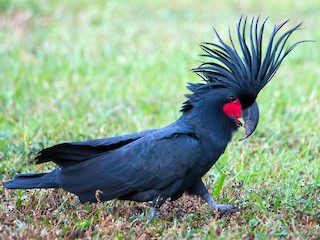
The black palm cockatoo is a very dark, smoky gray color that appears blacker on some birds than others. The same color appears on their very long crest, as well as their feet and legs.
This otherwise single-colored bird has bright red patches of bare skin on their cheeks, which change colors when the bird gets excited. Their cheeks are as striking as its dark grayish-black beak, giving it a very distinct profile up close.