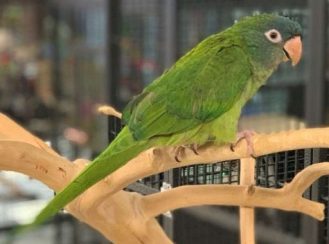
Hahn’s macaws are primarily green in color. They have some red coloration on the undersides of their wings and a white featherless area around their eyes. They have long, narrow tails and large heads. Males and females are similar in appearance.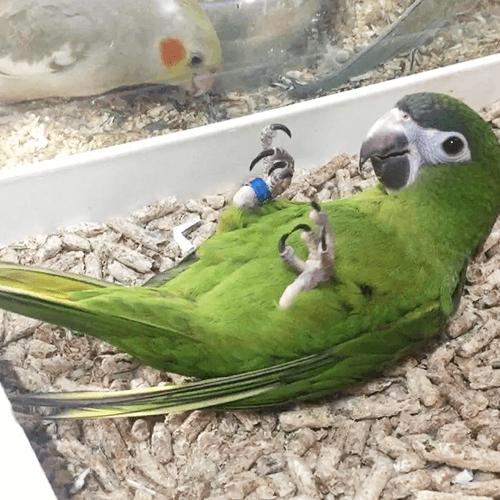
Size
Hahn’s macaw is the smallest breed of macaw. It measures about 12 inches (30.5 cm) long. Its wingspan is about 14 inches (35.6 cm).
Diet
Hahn’s macaws feed on seeds, berries, fruits, and nuts found in the treetops they inhabit. Pouco eats a diet consisting of fruits, vegetables, a commercial hookbill diet, and seeds.
Reproduction:
Hahn’s macaws mate for life and breed once a year. They make their nests in the hollowed-out face of a cliff or in a hollow tree. The female lays between two and five eggs per clutch (group of eggs). She incubates the eggs for 24 days while the male brings her food. About two months after hatching, the chicks are weaned.
Shelter and space needs:
In their natural habitat, Hahn’s macaws inhabit tropical forests in Brazil, Guyana, and Venezuela. In human care, they are active and social birds. They require human companionship and a cage with plenty of toys to play with.
Life expectancy:
Macaws in general are rather long-lived birds. In human care, a Hahn’s macaw can live to be over 30 years old.
Relationship with man:
Hahn’s macaws are often keep as pets because of their social nature and ease of handling. Some individuals can be good at mimicking speech. However, potential macaw owners should be prepare and responsible. A bird with a long lifespan requires a great commitment on the part of its owner. Also, since many types of macaws are being target for illegal pet trade, potential owners must be sure to get their bird from a reliable source that can assure that the bird is captive bred.In nature, macaws encourage rainforest growth, both by depositing droppings on the forest floor and by dropping nuts and seeds from which new plants then grow.
Origin and History
The Hahn’s macaw is one of two varieties of red-shoulder macaws. The noble macaw is the other, and both are native to northern South America. The Hahn’s subspecies is named for German zoologist Carl-Wilhelm Hahn, who catalog birds from the New World with depictions and descriptions.
In the wild, they live in Brazil, Guyana and Venezuela. They’re most likely to be found in the tropical lowlands, though these parrots also enjoy the savannas and swamplands. Hahn’s macaws tend to form small flocks in their natural habitat. This macaw’s green feathers blend perfectly into the bright foliage of these areas.
Temperament
Intelligent and charming, Hahn’s macaws are popular pets. Be aware, however, that while they may be small they pack all the personality of a larger parrot into their compact body. Expect many fun-filled hours watching their spirited antics.
Their compact size makes them suitable for bird lovers who live in smaller spaces or anyone with children. However, these birds are not suited for apartment living; they can be quite noisy when they feel like it.
Overall the Hahn’s macaw tends to be a very gentle bird. If you adopt a young bird it may nip a bit, but they usually grow out of that habit. They will also calm down as they mature. When socialize they can be sweet little birds that get along well with children as long as both parties interact appropriately with one another.
Speech and Vocalizations
Hahn’s macaws can be excellent talkers. With training, males and females can learn many words and phrases usually in a high-pitch but clear voice. But like the bigger macaws, Hahn’s macaws are screamers. And, if you get a pair of Hahn’s macaws, the noise will be twice as loud. Expect that this bird will assume the role of your morning alarm clock at sunrise.
Hahn’s Macaw Colors and Markings
This bird’s beak is black with a beige to white color in the upper beak. Their eyes are a burnt orange color, framed by the macaw’s classic white eye-rings.
Hahn’s macaws have black feet that seem to be oversized for their small body, though they are quite agile. To accommodate climbing and the handling of food and other objects, two of their toes point forward while two toes point toward the back. You can’t tell males and females apart by looking at them. For accurate sexing, this species requires genetic testing or surgical sexing.
These macaws are sometimes mistaken for noble macaws. The Hahn’s macaw is smaller, and the noble macaw’s beak is entirely beige. If you are familiar with sun conures, Hahn’s macaws are about the same size
Caring for the Hahn’s Macaw
Like their larger macaws cousins, Hahn’s macaws have the same social, dietary, and exercise requirements. If you think that a Hahn’s macaw is for you, make sure you have plenty of time to devote to training and bonding with your bird. A bored or neglect Hahn’s macaw can become angry, destructive, or depressed. If you do not spend time with your bird, plan for bird bites, damaged property, and getting frustrated with your bird.
Birds left alone for long periods are prone to self-mutilation or feather plucking, which can snowball into more severe health problems.
Hahn’s macaws do not require a very large cage like other macaws, however, they do need ample space. The cage should be large enough for the bird to fully expand its wings without touching the sides. Expect to get a cage that is 3-feet tall, long, and wide.
Common Health Problems
Like other macaws, Hahn’s macaws are prone to self-mutilation feather plucking, overgrown beaks, nutritional disorders, proventricular dilatation disease (a digestive disorder, also called macaw wasting syndrome), and psittacosis (a common avian bacterial infection).
Diet and Nutrition
Hahn’s Macaw These birds spend most of their mornings foraging for food, including berries, fruits, flower buds, nuts, seeds, and, occasionally, insects. You can sometimes find them on clay cliffs. The clay is a dietary supplement that helps remove any toxins they may pick up from their usual food sources.
In captivity, Hahn’s macaws eat a high-quality pellet diet. This staple is in addition to daily servings of fresh fruits and vegetables, which make mealtime a fun spectacle to watch. Macaws, depending on their size, will eat about 1/2 to 3/4 cup of parrot mix and about 1/2 to 3/4 cup of fruit and vegetables per day. Provide fresh drinking water every day.
These parrots will be delight with dark greens like kale and spinach as well as broccoli, carrots, squash, and even some chili peppers. For fruits, consider staples like apples, peaches, oranges, and pineapple. Many Hahn’s also like bananas and figs. Just be sure to clean up any fruit leftovers to keep the cage clean and free of ants or mold.
Some parrots can become picky eaters, but you can diversify their diet by introducing new foods slowly. Do not feed these birds avocados, chocolate, or alcoholic beverages.
Exercise
Hahn’s Macaw Like all parrots, wild Hahn’s macaws fly for long distances every day. In captivity, a Hahn’s macaw also needs an adequate amount of time out of the cage to play, exercise, and stretch its muscles. Provide your parrot with at least two hours of supervised out-of-cage playtime a day.
Social and intelligent, Hahn’s macaws respond quickly to training which gives birds mental stimulation and keeps them from getting bor. You will have a lot of fun teaching these little birds tricks. Introduce new tasks throughout their lives to keep them mentally engage.
With these parrots, it’s best to ignore unwant behavior—including excessive noise. Scolding has the opposite effect; it shows the bird that loud, stern squawking is an acceptable form of communication. Your best approach is positive reinforcement. Reward good behavior and quiet moments, and your little bird will start to understand what is acceptable behavior. They aim to please their keepers and handlers.