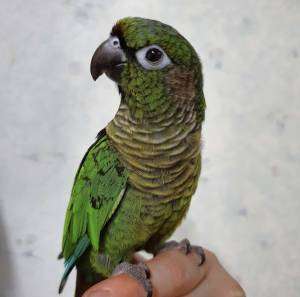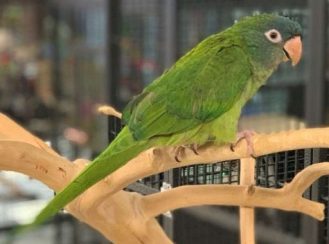
Green Cheeked Conure are popular pets due to their small size, playful nature, and being quieter than other parrots.They require a spacious cage, regular exercise, and social interaction but are generally easy-going and suitable as family pets.They are prone to specific health issues like PDD, PBFD, and psittacosis, so regular check-ups with an avian veterinarian are essential.
Origin and History
Green Cheeked Conure is native to South America, commonly found in the forests and woodland areas of Brazil, Bolivia, Argentina, and Paraguay. These birds usually lives in flocks of 10 to 20 birds at treetop level or larger flocks where there is more food.
Green Cheeked Conure
Green-cheeked conures can be outgoing and comical, but they can also be a little shyer than other conures. These birds love their play and will appreciate a good rotation of toys and a spacious cage to run around.
Little Bird, Big Personality
Green Cheeked Conure most unusual pet I have ever had is a green-cheeked conure. These small parrots have huge personalities. They are native to South America, and while they are not unusual birds in the larger scheme of things, it’s unusual that I happen to own one.
I’d like to share how I came to own this type of bird, some misconceptions about conures, and how to care for them.
How I Met Tikko
Green Cheeked Conure Here is how I came to own Tikko the green-cheeked conure. My granddaughter and I made our weekly pilgrimage to a local garden center for pond supplies and fish food. This particular garden center has a small supply of pets, including several species of birds, hamsters, guinea pigs, and fish.
As we browsed the pet section, we passed a cage that had a door hanging open, like a bridge, and a green baby bird was perched on the end of the door. He hopped onto me and climbed up to snuggle against my neck in my hair. As I was extremely alarmed at this, the little girl who was cleaning the cages explained that his sister had just been sold and he was the only baby left. She thought it was so unusual for him to snuggle in my hair that she took a picture of us.
At this point, the little bird was clinging with claws and beak and bit anyone who tried to disengage him from my hair. It was becoming increasingly embarrassing and painful. $600 poorer, we walked out the door with a large cage, baby bird food, seeds and dried fruits, as well as toys, bowls, and water sources. Oh, and one securely attached hair ornament name.
What You Need to Know About Conures
Green Cheeked Conure As you can tell from our meet cute story, conures need a lot of attention. They also become very attached to one person and can be aggressive with other people. Keep these things in mind if you are considering this type of bird and you have a family.
Conure Care Dos and Don’ts
- Do tell other people to give your conure time to warm up to them. They are fiercely loyal birds but can get used to other people with time.
- Don’t give your bird grit. I have read that birds need it; however, for this bird, it can be a deadly addition to the food dish.
What a Conure Likes to Eat
Green-cheeked conures love to eat berries, yams, small chicken bones, and dinner with you right off your plate. This is a bird family thing, sharing a meal together. He expects to be included. I also give my bird mixed veggies, thawed with hot water, and then drained. He loves yogurt also and will eat right out of my mouth if I don’t give him bites.
Clean water is a must, at least once a day. Twice a day is better, as they like to dip dry foods and they spit in their water. If you don’t want your snuggle bug bird to smell like vomit, then you need to keep the water clean because they also bathe in it.
Conures Need Lots of Attention
Green Cheeked Conure loves to cuddle and he never wants to go to bed unless it’s with me. This is very sad to tell you. A lot of people are like me. They love their conure so much that they can’t tell them no and put them in their own beds. The little guys end up crushed by their loving parents in the middle of the night. These birds are so loving that it’s natural for them to throw a fit and pout when you put them away. It’s hard to do but you have to tell them no.
He also likes to take a bath with me so I have to be careful that I don’t have the water really hot. He will spread his wings out and float on top of the water. His favorite bath place is by my face, hanging onto my hair so he doesn’t go under. He likes to lay there and relax like I do and groom my hair. I had to stop using hair spray also.
I guess you can tell that a conure needs a lot of love and attention. If you don’t have a lot of time and interest in loving a bird, please don’t get this precious little clown. His heart will be broken and he will be constantly lonely and probably die early. He needs lots of exercise and touching. He will love to be groomed and scratched all over, especially around his face and even his beak. Tikko likes when his mommy kisses his little drum sticks too.
You Can Teach Your Conure to Talk!
Green Cheeked Conure birds develop a great vocabulary. My bird sings Twinkle Twinkle Little Star and says love you, mommy, granite (means pomegranate), berries, nanna, angel (dog’s name), come here right NOW, right now!, Tiffy, Britney, Where’s Angel?, Tikko, and Martha (he loves the show Martha Speaks). He screams like a little girl when he doesn’t get his own way, and he says ‘night, ‘night, bye bye, peek-a-boo, sweet dreams, and bathie. He also laughs, coughs, and sneezes!
Avoid Teflon and Other Chemicals
Never use scented candles or oils, air fresheners, or caustic cleaners around your birds. Do not clean your oven with oven cleaner while your bird is in the house. I know someone who did that and killed her sweet baby and it broke her heart. Teflon in any form is toxic to birds. If you have a room heater, make sure its ceramic, not Teflon. Keep your bird out of the kitchen if using Teflon pans.
Use vinegar to clean your bird’s cage and accessories. Rinse and triple rinse everything before using again.
Conures Are Not Family Birds
Green Cheeked Conure bird is not a natural family-loving pet. Will bond to one or two people and bite the heck out of everyone else. My bird is so protective of me that if someone even tries to touch me he will attack them. This behavior has extended. If a stranger is in the house he will attack them and try to drive them away from me. Your bird will never love your spouse.
Attack-Bird in Action: My Experience
Green Cheeked Conure A funny example of this attack-bird scenario: My boyfriend was here from out of town and was lying on my couch watching television and taking a nap. I was in the kitchen making some bread dough and Tikko was innocently sitting high up on his favorite perch in the living room grooming himself and singing Twinkle Twinkle Little Star. This, for me, was a very relaxing, content moment. The next moment my boyfriend started screaming my name and as I ran into the living room I saw my tiny little parrot attacking my six-foot-four-inch, 260-pound boyfriend. Not only was Tikko attacking him, he was going for his throat, biting him and flogging him with his wings!
I had bread dough all over my hands and was trying to wipe them off and laughing so hard it was a feat to accomplish. My boyfriend, knowing how much I loved this bird, was trying very hard not to hurt him while he was being viciously bitten. Tikko draws blood when he bites. Keep that in mind when purchasing a parrot, even a small one.
My boyfriend was furious that I was laughing until I couldn’t talk or breathe, tears running down my face. He asked me a question he probably shouldn’t have asked me: If I had to choose between him and the bird who would I choose? I’ll never understand, to this day, why he would ask me that question at precisely that moment, but he did. My not being able to answer him was answer enough, I suppose, which made him even angrier.
My granddaughter was a little more understanding. Tikko attacked her and bit her every time she tried to love him or take him out of the cage. She would want to hold him then cry when he bit her, every time. I finally told her, if she wanted to be part of a bird family, she was going to have to expect to get bitten or leave him alone.
Eventually, he came to love her and trust her as much as he did me and they became very close. Now she can handle him without issue. She is the only person I can leave him to if I die before he does, which is pretty likely as I’m 52, he’s five and will live another 20 years—at least that’s my hope.