Military Macaw Care Guide is split up into eight disjunct ranges – two in Mexico and six in South America. Military macaws are absent in Central America. The northernmost portion of their range extends as far as La Sierrita (Sonora), Mexico. This range follows the western coast of Mexico and continues south to Las Margaritas. Military Macaw Care Guide Within this range, from Lazaro Cardenas to Las Margaritas they may be extinct. The extant regions are from Sahuaripa to the northern tip of Choix. The range in Mexico also includes an area on the eastern coast from Cuidad Victoria to Tantoyuca. Within this region, a small area near Cuidad Mante, Tamaulipas contains an extant population.
Habitat
Military Macaw Care Guide inhabit tropical, terrestrial biomes that include tropical sub-deciduous and deciduous forest as well as rainforest. Their elevational range is from 0 to 3600 m, but they are most commonly found at elevations between 500 to 1500 m. They utilize tree cavities for the purpose of nesting. In South America they generally live in humid forests, highly wooded areas, and shaded coffee plantations. Military Macaw Care Guide These birds move locally to and from forests and shaded regions.
Physical Description
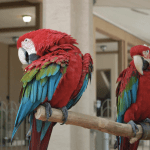
Military Macaw Care Guide are blue and green, with a paler shade of green on their head compare to their body. There is a red patch on their foreheads and an exposed white area with dark lines around the eye. Military Macaw Care Guide Their flight quills are blue and their tail feathers are red. The have a large black beak and yellow eyes.
Military Macaw Care Guide They weigh around 900 g, are roughly 70 to 80 cm long, and have wingspans of 99 to 110 cm. They are monomorphic, which means that the male and female resemble each other. The average basal metabolic rate for parrots (not specific to military macaws) is 1.8 cm^3 oxygen/gram hour; the basal metabolic rate specific to military macaws has not been reported. They are born naked with no feathers and then will reach sexual maturity at around two to four years.
Reproduction
Military Macaw Care Guide are monogamous, staying with one mate for life. They are seasonal breeders. They can breed year-round in captivity; they might breed year-round in the wild depending on existing bonds, cavity availability, and resource availability. Military Macaw Care Guide are secondary cavity-nesters, meaning that they will use pre-formed nesting cavities on the sides of cliffs or in tall trees. Rivera-Ortiz (2016) summarized a number of publications and reported that the behaviors of grooming and regurgitation were observed between pairs as a way to strengthen their bonds.
Behavior
Military macaws are gregarious, meaning they are social birds. Although populations of 50 macaws are common, they have been found in groups of up to 100. Despite living in colonies, they forage independently or fly in pairs. As pairs, these birds seek out suitable nesting areas. Juveniles remain with their parents until they are fully independent. Rivera-Ortiz (2016) summarized multiple publications and reported that the breeding season in western Mexico is from October to November and it ends with the departure of the juveniles from January to March.
Home Range
Communication and Perception
Military Macaw Care Guide have an extremely develop sense of vision, primarily use for finding food and detecting predators. These birds can sense Earth’s magnetic fields, which helps them navigate their environment. They have excellent color vision, and so communicate with colorful courtship displays. Hearing is essential to their communication and perception of the world; it helps military macaws defend territory, navigate, and mate. Their sense of taste is important in selecting food. Military macaws can taste sweet, sour, bitter, salty flavors, and can detect lipid and sugar concentrations in their food. Military Macaw Care Guide Their sense of smell helps them to select mates and detect food while foraging.
Popularity
The Military Macaw is a handsome bird and highly intelligent. So why is it not more popular? Perhaps the reason is that the large Macaws are perceived as flamboyant with more gaudy colours than other Parrots — blues and reds.
Parrot keepers are often initially attracted by colour rather than personality. By any standard the Military is an eye-catching bird with the dense, bushy scarlet feathers of the forehead, a feature it shares only with the Great Green or Buffon’s Macaw.
Military Macaw Diet:
Military Macaws are not as dependent on the fruits (nuts) of palm trees as some other Macaws but these do form part of their diet, so anyone living in areas where palm trees grow can provide this natural and oily element of their diet. They appreciate walnuts, Brazil nuts, almonds, etc, and should receive several each day. The usual fruits, vegetables (including corn on the cob) and seeds must be offer. Militaries will also take foods such as boiled maize, sprouted mung beans and chick peas, hawthorn berries and elderberries.
Aviary
A good deal of thought should be give to aviary accommodation before a pair of Military (or any large Macaws) is purchase. In my experience, Militaries do best when they have no close neighbours or their aviary has solid walls that screen them from other Macaws. A “detached” aviary would be a good location.
Height is very important — ideally not less than 3m (10ft). Minimum length of 6m (20ft) is recommended. The width is less important but 2.4m (8ft) is suitable. Some people keep them in smaller enclosures but seem to give inadequate thought to their quality of life. They need to fly and will not do so in a small aviary.
Click here for Military Macaw cages.
Macaws enjoy walking on the ground and grinding up stones or just investigating. A good surface is shingle (small
Food and feeding
Military macaws leave their roosts in flocks around dawn to forage. Their diet consists of mostly seeds but also includes fruits and leaves. They have been observed using for water and consuming latex from. They have a somewhat narrow diet, meaning that they only eat a small percentage of species of plants that are available to them. They flock to feed on heaps of clay known as “macaw licks” along riverbanks and sometimes in the interior of the Amazon rainforest. The clay deposits appear to remove toxins found in the seeds and vegetation of the rest of their diet and to provide dietary salt missing from the diet.
Breeding
Pair-bonding behaviors include grooming and regurgitation and have been observe during breeding and non-breeding periods. Courtship occurs as early as March, and copulation in May to July. Breeding season is typically between March and October while incubation and hatching occur during August and September. The reproductive season begins with nest selection around October and ends when the chicks fledge between January and March. Military macaws are cavity-nesters and will nest in natural cavities such as holes in trees or on cliffs. They nest in trees at least 15 meters tall and 90 centimeters wide. During the breeding season, the male will feed the female 3–4 times a day.
Distribution and habitat
Military macaws typically inhabit tropical deciduous and semi-deciduous forests. The is a canopy species because they require large canopy trees of deciduous and subdeciduous forests for feeding, breeding, and nesting behavior. They also use canopy trees for protection from predators and heat. The typically live at elevations of 600 to 1500 m, higher in the mountains than most macaws ever range. However, these macaws may seasonally fly down to lowlands, where they are likely in humid forests and thorny woodlands. The will nest in the tops of trees 8–28 m off the ground, and more often in cliff faces over 600 ft (180 m) above the ground.
Conservation
Military macaws are estimate to only have a breeding population of 2000–7000 individuals and is continuing to decrease. According to the ICUN red list, military macaws are listed as vulnerable as they face threats from habitat loss due to crops mining, and roads, with already extremely fragment populations. A 2013 paper found that the habitat for populations in tropical dry forests has been reduce by almost 32%. Military macaws are list as Appendix 1 which means commercial international trade in wild specimens is prohibit. Despite this, research shows that the trafficking of parrots from South America to North America is still common.
Caring For Your Pet Macaw
They need plenty of room to move around and exercise, as well as for branches and toys. Minimum size for a macaw 3 feet wide, 2.5 feet deep, and 6 feet high.
The wingspan on some larger birds can reach 4 feet in length, so caging should be enough for them to stretch their wings.
The bars should be no farther apart than ¾-1.5″ to avoid any chance of injury from head entrapment. The bars should run horizontally to make it easier for the bird to climb around.
Use perches of several different diameters to exercise the feet properly. Avoid putting a sandpapered perch in your bird’s cage.
If you are bothered by sharp toenails, you can try using a special terra-cotta or cement perch which will help keep nails dull without injuring your bird’s