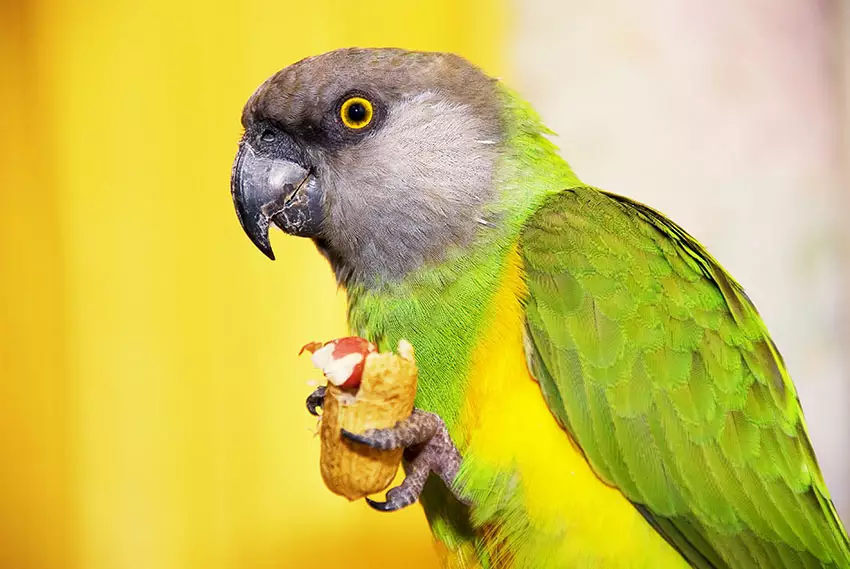
- Parrot training tips the area where the training takes place should be a quiet and calm space. Any children or dogs rushing around noisily in the background will cause all but the largest and boldest parrot to become nervous setting your efforts back several weeks. The part of the house where the bird lives is ideal as he will have taken in all the room’s details already and is less likely to be distract from the task in hand.
- Good mood. Training sessions will be most fruitful if your pet is relax and happy. If he’s just had a panic-flap around the cage, he won’t be able to instantly calm down and learn the basics of parrot/human communication! First thing in the morning is a good time. The parrot will be hungry after his night’s sleep, and this makes him more susceptible to the treat that you will be using to encourage and reinforce his learning. If you train him straight after breakfast he’ll be less keen to earn the food rewards.
- Training tools. Gather all the things you’ll need for the session – some of the bird’s favourite treats (fruit or nuts are a good choice), a hand-held perch, and other relevant items mention in the points below.
Parrot Training Methods
This word is used to describe reinforcing good responses and gently discouraging unwant ones. Many people use a clicker (of the same type used in dog training). When the parrot has done what you want him to, or made the first step towards doing it, a click and/or a treat (with an encouraging word or two thrown in) will reinforce it. This helps your bird learn a tricky manoeuvre in stages.
Target training. This helps the parrot associate a command with an action, similar to basic finger-training (mentioned in the ‘familiarity’ bullet above). Use a chopstick or length of wooden dowelling, or a similar wooden or plastic perch. Use a command phrase such as “Come on!”, and when the parrot touches the object (with beak or feet), give your clicker a click and reward the bird with a treat. In time, the object or command phrase alone will provoke the desired response – the parrot will follow it or walk/fly to it.
What your bird should be able to do
You should be able to teach your bird to step on and off your hand or a small hand-held stick when you ask them to. You can also train them to fly to you or to other places such as their cage or perch. A bird who can do these simple things is much easier to look after when out of their cage.
Your bird should be train to accept being transport to have health and weight checks and to have their claws trim.
The training basics
As your bird’s main carer, you should have a positive, friendly relationship with your bird. They should know you well and like to be with you. They will need to be out of their cage, interacting with you and enjoying other activities, such as playing with toys, for at least six hours every day.
When you start training, make sure your bird is comfortable, and always go at their pace. Stay calm, avoid fast hand movements and stop if your bird seems distress.
In this order, aim to teach your bird these commands by following the ‘Dos’ and ‘Don’ts’ below:
5 Basic Bird Training Tips for Beginners
If you ever brought home a dog you probably sign up for training classes and taught him all the basics, like sit, stay and come. Did you know you should do the same for your pet bird?
It might be hard to find training classes for your parrot but that needn’t stop you! Through bird training, you can teach your pet which behaviors you like and how he should behave. On top of that, training will teach your bird that you’re his friend and to associate you with good things such as bird treats, praise and bonding together.
If you’re daunt by the idea of training your pet bird we’ve got you cover. These five tips from Sarah Walter a parrot trainer who specializes in free flight and who owns Mobile Bird Grooming in Sacramento California, will help you start your training sessions off right.
1. Give Immediate Rewards for Desired Behaviors
When your parrot performs a desired behavior, like stepping up onto your finger, Walter says to reward your bird immediately.
“That’s the thing a lot of people miss,” she says. You want to pair your verbal praise—for example saying ‘good bird!’—while [you’re] delivering food. It has to be super instant, too, so the bird realizes and connects that ‘my trainer asked this, I did it, and I was immediately reward. That’s how they learn a behavior.
2. Use Bird Treats That Your Parrot Can’t Get Elsewhere
Nothing motivates a parrot to learn his cues like bird treats. Don’t serve any old treat; you want to find high-value bird treats that’ll motivate your pet to start training. So, how do you make a treat extra special?
“Designate a favorite food your parrot has Walter says. “They all have a favorite something … my go-to for larger parrots is pine nuts out of the shell.
Walter also recommends increasing the value of the food by making it a rarity.
“They should only get this bird treat from their trainer she explains.
If your parrot receives his favorite treat all the time, the treat can lose its value. In time, your pet bird might be less motivate to train with you.
3. Keep Bird Training Treats Small
Once you find the perfect training treat for your parrot break it into small pieces. You want the bird treats to be quick enough for your pet to eat so you can get right back to training.
“The attention span of a parrot is really short,” Walter says. If you give them a whole walnut, they’re check out from training and concentrating on eating.”
4. Maximize Your Training Time
You can and should train your pet bird throughout the day. However if you really want lessons to sink in, Walter says there’s one time that’s better than all the others.
Mornings are generally the best time to train, she says, adding that in the morning, your birds have just slept all night and should be refreshed and ready to go. “You don’t want to train a cranky, tired bird in the evening.”
On average, you want to keep training sessions short, no more than 2 to 3 minutes long. If your pet bird is highly engag, however, feel free to keep training sessions going for another few minutes. Watch your bird’s body language to see if he’s ready to stop, Walter adds.
“If you ask your bird to do a cue and [he] turns around and starts stretching or preening, those are signs that [he’s] checking out,” she explains.
5. Choose the Right Environment for Training
Where you train is very important. Choose a place void of distractions, like those that you might find in bird cages, to help your bird stay focused. For example, if your parrot is in his bird cage, he might be more interested in his bird toys and his bird food instead of whatever you’re asking him to do.
For that reason, Walter designated a bird training stand for her parrots. Not only does the stand help the parrots focus during training, it’s something that her parrots get excited about when they see it come out.
“My parrots beg to get on the stand when it comes out,” Walter says. “They know great things happen on that stand.”
Do you want to learn more about bird training and how it helps build a great friendship between you and your parrot? Check out “How To Be Your Bird’s Best Friend” over at the Bird Talk blog.