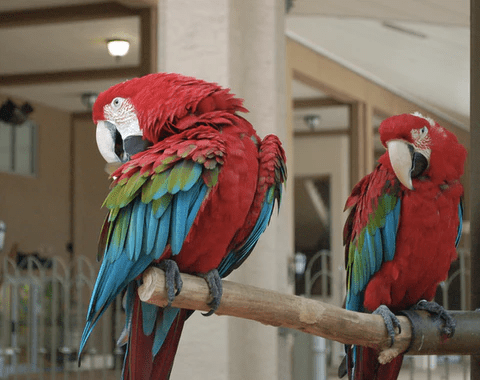
Green wings macaw, also known as red-and-green macaws, are native to southern Central America and northern South America. They inhabit tropical rainforest.The Maryland Zoo features a green-winged macaw among its Animal Ambassadors, which are introduced to audiences in education programs on and off grounds. 
How I live there
Macaws spend most of their time in the rainforest canopy where they feed, socialize, and take cover from eagles, their most likely predator. They remain in pairs or small parties but usually do not gather in large flocks unless congregating at a clay lick along a riverbank. This is an interesting behavior often observed in macaws, and biologists think that minerals and salts in the clay licks are essential to the birds’ diet.
Where I live
When in large flocks at a clay lick, macaws are very gregarious and loud, displaying their full vocal range. (“A trumpet blown straight in your ear”: this is how Charles Munn, a wildlife biologist who has studied macaws for years, describes their signature shriek.) Under cover of the dense rainforest, though, macaws are surprisingly hard to spot. They forage and nest high in the trees and go very quiet while in the forest, so despite their bright colors they keep a low profile
Making my mark
Macaws are distinguished by their large size, long tails, huge beaks, striking coloration, and marked intelligence. Like many species of parrot, they have an uncanny ability to mimic what they hear, including human speech.All species of macaw are native to the Americas. Ever since European explorers returned home with macaws in the 16th century, these largest of all parrots have been popular as pets. Macaws are intelligent, gregarious, and charming, but also highly demanding. Anyone thinking of keeping one as a pet should know what they are getting into.
Raising Young
Macaws mate for life and travel in pairs even out of breeding season. Breeding usually occurs during the month of December. Green-winged macaws nest in tree cavities high off the ground, often at least 100 feet up. The female will lay 2 to 3 eggs and incubate them for the next four weeks. While she is on the nest, her mate will bring her food stored in his throat pouch. He regurgitates the food into her mouth, just as both parents will do later for their offspring.
What eats me
Macaw eggs are most vulnerable to toucans that can reach into tree cavities with their long beaks and tayras, a type of weasel that can scale tall trees and raid nests.
The green-winged macaw and most other species of macaw have bright coloration that warns predators of their power, and any macaw will defend itself if attacked. Eagles are the most likely predators of adult macaws. If one macaw sees an eagle circling above, it will sound an alarm cry and several macaws then may rush the eagle, shrieking at it until it goes away. Macaws also defend themselves with their feet and their very powerful beaks.
Conservation
The overall population of green macaws appears to be declining, but the species has an extremely large range and is still list by the IUCN, the world’s leading conservation organization, as one of least concern. Like all rainforest species, green-winged macaws are threatened by habitat loss due to deforestation. They are now extinct in some parts of their range, including Argentina.
Origin and History
The green-wing macaw is native to many of the tropical lowland forests of Central and South America, including Panama, Colombia, Venezuela, Ecuador, Guyana, Brazil, Peru, Suriname, French Guiana, Paraguay, Argentina, and Bolivia. It lives in virtually the same territory as the blue-and-gold macaw.
Green-wing macaws have been keep in captivity as far back as the 17th century. Captive breeding programs took off during the 19th century and were quite successful. Today, it is relatively easy to find green-wing macaws bred in captivity. Like many other tropical birds, this macaw’s natural habitat has been badly depleted and many are still capture for the black market parrot trade.
Temperament
Green-wing macaws are tame and affectionate with a usually even, easy-going disposition. They are friendly and require a couple of hours of interaction with you every day. These birds are brilliant; they can learn to speak words and do tricks.
As one of the largest species of parrot, they have incredibly powerful beaks. Although they are among the most gentle parrots, a green-wing macaw with behavior problems can be a biting hazard for families with little children (and little fingers). Most species of parrots will develop behavioral issues if they do not get sufficient attention from you or their human flock.
Speech and Vocalizations
The green-wing macaw can be taught to speak about 15 words but is not known for its talking ability. This bird will screech and scream, for example, when it gets excited, feels threatened, or wants attention. This bird can get loud. This species is an unsuitable companion for those who live in an apartment or other close quarters.
Green-Wing Macaw Colors and Markings
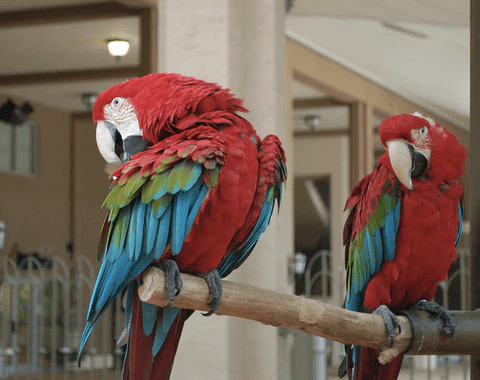
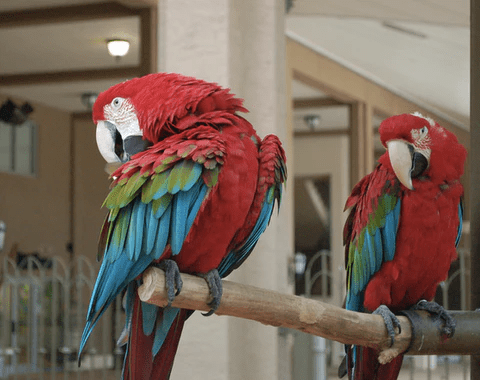
The green-wing macaw is one of the most recognizable of all the parrot species. These bright birds are a deep vibrant red on the head shoulders and breast with a greenish band below the shoulders and wings. The green band transitions to dark blue on the wings, and there is light blue on the rump and on the tail feathers.
The long tail feathers are red, tip in blue. The legs and feet are a deep gray, and the beak is horn-color with a black lower mandible. The bird has eye patches on the face. Males and females are indistinguishable except that males are slightly larger. To figure out the sex of the bird it will need DNA testing or surgical sexing
Caring for Green-Wing Macaws
In the wild, green-wing macaws live in flocks of six to eight birds; they are very social. Green-wing macaws are highly responsive to training and must be given adequate attention and bonding time due to their social natures. A bored macaw is a destructive macaw.
Plan to spend plenty of time socializing with your bird. When you take a green-wing macaw into your home, you effectively become its “flock” and must include it in family activities.
A large macaw like a green-wing needs a roomy cage: 2 1/2 feet by 3 feet at a minimum. The green-wing is a somewhat quieter bird than some of the other large macaws, but it is still a loud species.
Mount a sturdy perch in the cage, and be prepare to replace it occasionally as it gets damage. Food, water, and treat dishes should be mount above the perch on the side of the cage. Branches within the enclosure will offer the bird climbing exercise. Provide a variety of toys for chewing and playing. A playpen structure at the top of the
Cage is a good idea
The green-wing macaw will also do well if kept in an outdoor aviary during warm weather. It can also adapt well to an entire room dedicated as an indoor “bird room.”
Owning a huge green-wing macaw is an expensive endeavor that requires a lot of constant attention. Before bringing this bird home, be prepare to spend much in terms of time, feed, equipment, veterinary bills, and possibly home repair costs.
Common Health Problems
Green-wing macaws, like other macaw species, are susceptible to some diseases, including:
- Proventricular dilation disease (also call macaw wasting disease): This viral disease causes intestinal problems as well as neurological symptoms. It is usually fatal, and the best preventive measures are to keep the birds isolated from other birds that might carry the virus.
- Psittacine beak-and-feather disease: A disease cause by a circovirus, it kills the cells of the feather and beak and also compromises the immune system. It is usually fatal and is best prevent by making sure your bird has been properly quarantin before you buy it.
- Psittacosis: This bacterial disease causes respiratory symptoms and eye discharge. Stress birds are most susceptible, and prompt treatment with antibiotics can often cure the disease.
- Other problems that are less serious include allergies and behavior problems, such as feather plucking, which usually occurs in parrots that are bored or frustrate.
Diet and Nutrition
In the wild, green-wing macaws eat fruit, seeds, berries, and nuts. They also congregate at clay cliffs. Clay contains minerals and salts that the birds consume to neutralize toxins.
Pet green-wing macaws, like all parrots, should consume a high-quality commercial seed and pellet mix in addition to daily servings of bird-safe fruits and vegetables. Most green-wings enjoy being hand-fed at the same time as family mealtime. Green-wing macaws are known to eat some protein in the wild, and in captivity, they will eat bits of cook chicken.
Each macaw, depending on its size, will eat about 1/2 to 3/4 cup of parrot mix and about 1/2 to 3/4 cup of fruit and vegetables every day. You can feed it once in the morning upon waking and at dusk before it goes to sleep. Remove all uneaten food before bedtime.
Exercise
Although they are not as active as other large parrots, green-wing macaws still need plenty of exercise for both mental and physical stimulation. You will need to provide 2 to 3 hours of supervised out-of-cage playtime daily. Provide a separate playpen structure away from the cage for exercise periods.
Make sure that you keep a close on your birds while they are out of the cage. Green-wing macaws are known for being voracious chewers and can chew through a door frame or expensive molding with lightning speed. You should invest in some good-quality chew toys and be ready to keep resupplying them, as these are disposable items where macaws are concern.
Where to Adopt or Buy a Green-Wing Macaw
This bird is not commonly sold in pet stores, so you’ll need to seek out a breeder to purchase a green-wing macaw. If you decide to buy a green-wing macaw, make sure you deal with a reputable breeder who can verify the bird’s status. This bird can cost from $3,000 to $4,000.
The green-wing macaw is a high-maintenance bird. Unfortunately, it is frequently surrender to animal adoption agencies and rescue organizations. Online rescues, adoption organizations, and breeders where you can find green-wing macaws include: