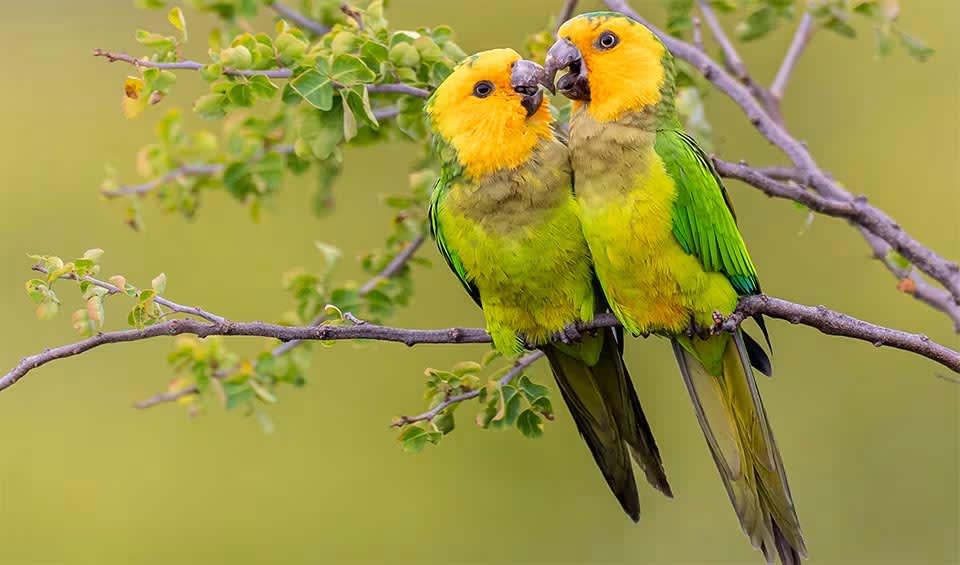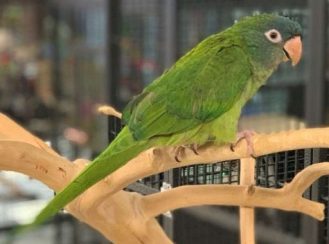
Brown throated parakeet Dressed in a coat of shimmering green, this emerald gem isn’t shy about adding a pop of color. Its belly boasts a cheerful yellowish-green, while its wings are a stunning blend of emerald and sapphire with a hint of blue peeking through at the edges. Unlike some of its flashier conure cousins, the brown-throated parakeet doesn’t have a flamboyant headpiece of feathers. Instead, it has a smooth brow that highlights its intelligent, inquisitive eyes. But don’t be fooled by this simple look – males have a hidden trick up their wings! During the breeding season, a patch of bare skin below their tail transforms into a bright, pale blue, a subtle badge of distinction.
Brown-throated Parakeet
Brown-throated parakeets are sociable creatures, rarely venturing out alone. They prefer the company of their troop, a group that can range from a cozy handful of just a few individuals to a bustling crowd of sometimes 80 birds. Within this troop, there’s a clear pecking order, but unlike some birds, they maintain harmony through friendly gestures like preening each other’s feathers. These feathered friends are also skilled communicators, using a rich vocabulary of chirps, whistles, and squawks to chat with each other. Imagine having different calls for a sneaky snake and a soaring hawk – that’s how sophisticated these little chatterboxes are!
Throated parakeet
Brown-throated parakeets are clever and curious. They can learn and remember things, which comes in handy when searching for food. They’ve even been observed using tools, like small rocks, to help crack open tough nuts! But what truly brings these birds to life is their playful spirit. Watching them flit through the trees in a flurry of green feathers, wrestling on the ground, or swinging from branches with reckless abandon is a sight to behold.
Feeding
The brown-throated parakeet’s diet includes seeds, fruits, nuts, flowers, leaves, and sometimes insects. A study in Venezuela found that up to 70% of its food in the study area came from human-planted, rather than wild, sources. The species is a significant crop pest, especially on maize and other field crops in Colombia and Venezuela, and in fruit plantations in the Leeward Antilles. It has been observed feeding on cactus. The species typically forages in pairs or small flocks. Flocks will call in flight, and if an actively foraging flock responds, the others may join it.
Breeding
The brown-throated parakeet’s nesting season varies throughout its range. It may nest at almost any time of year in Suriname and the Antilles, and from February to April in Colombia and Venezuela. It usually excavates a cavity in a nest of an arboreal termite, often one from the genus Nasutitermes. Furthermore, it also nests in natural cavities in a tree, on a cliff face, or in an earthen bank. Often several pairs will nest in a single rotten tree. The clutch size is two to seven eggs. In captivity, the incubation period is 23 days. In the wild, the time to fledge is 36 to 37 days.
Vocalization
The brown-throated parakeet is very vocal. Its flight calls “include high-pitched screeching and harsh grating ‘scraart scraart’ cries, rapidly repeated.” It also makes “shorter, bisyllabic ‘tchrit tchrit’ and ‘cherr cheedit'” calls, and from a perch “similar calls and chattering notes.
Brown-throated parakeet contact calls show character shifts between different locations, and by most measures the calls from islands are more variable. These changes in island parakeets’ calls may be a response to both the windy environment with poor sound transmission, and the isolation of the populations living on small islands.